Introducing a new magazine of arts and letters–Words + Pictures. http://wordspluspicturesblog.com/2015/01/06/who-we-are/
So exciting! Check out our guidelines and get going!
Introducing a new magazine of arts and letters–Words + Pictures. http://wordspluspicturesblog.com/2015/01/06/who-we-are/
So exciting! Check out our guidelines and get going!
As my daughter’s bat mitzvah approaches, I find myself confronting unexpected issues. Not clothing or caterers or guests, though those things are complicated enough. No, instead, I am banging into obstacles in the form of religious practice–what I will do and what I won’t, and most confusing of all, why.
Judaism, like all religions, is full of strange practices. On Sukkot we build an outdoor shelter in which we take our meals for eight days. We shake a lulav (an arrangement of palm frond, willow, and myrtle leaves) in the four cardinal directions. On Yom Kippur we don’t wear leather, and many wear white. In mourning, we rip our clothes and sit on low stools. Some sects swing chickens over their heads in the time between Rosh HaShanah and Yom Kippur. Like other traditions, there are special foods for each holiday, too. In synagogue worship, people touch the Torah with their prayer books, kissing the word of God. When they go up to read from the Torah, they use the fringes of their prayer shawl (tallit) to touch those words and kiss the fringes.
Almost all of these practices make me uncomfortable.
I don’t mean that I wish no one would do them (well, maybe we could call a halt to the chicken-torture), but that I, personally, feel odd about them. I’ve never been a Torah-kisser; for me, this is the worship of an object, and I don’t worship objects. I understand what the object represents, and maybe if I believed in God and had reverence for anything beyond customs and traditions, this wouldn’t bug me.
Some things I just never learned to do at all. My father, of blessed memory, taught me never to do a thing unless I did it “properly.” He meant well. But this has led to forty years of me avoiding things I might look foolish doing, things I won’t do right first time out of the gate, or things that are just weird (see lulav shaking).
Then there are issues of egalitarian worship. Judaism, like other religions you know, has traditionally treated women as second-class. Sure, they make up fancy mollifying reasons for this, explaining that men and women have different roles. But of course, that’s bullshit. Nowadays, women can be rabbis and cantors, they can be synagogue presidents. They read from the Torah and shake their lulavs all over town. 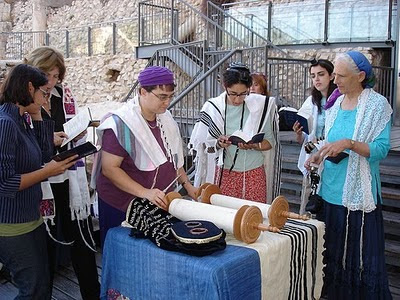
One way that many women have embraced their inclusion is by wearing a tallit and a kippah (yarmulke) to services. These are usually “girl” versions of the garments (because what girl doesn’t like pretty things?). So the prayer shawls come in many colors and diaphanous fabrics, and lots of women wear something on their heads made of wire and beads, a shiny, feminine version of a yarmulke.
When I spoke to my young, progressive rabbi about this, he made an excellent, reasonable argument. Head coverings and prayer shawls are required of all Jews that go up on the bimah (think stage) to engage with the Torah. So that includes women. Totally reasonable and logical.
But. For me, these garments are male. I am thrilled to be invited to the game, but why should I put on men’s clothing to play? Does that mean that being female is still problematic, that I must put on man stuff to be accepted? No, is the answer, go buy the women’s versions of these items. Except that these things are akin (for me) to the aisle of pink toys at every big box store. It’s insulting. I hate, I mean really hate, those beaded things people wear on their heads. They’re worse than the stupid doilies synagogues always offer women. They are distractions–look at the pretty shiny hat, young lady. I feel almost as though there’s something they hope to slip past us while we’re bedazzled by our beadazzled stuff.
Still, the rabbi’s reasoning makes sense. My husband said that the synagogue, then, ought to have women’s tallits available to borrow the way they have men’s piled up outside the sanctuary. The rabbi agreed that this is an excellent idea.
But now I have complicated matters further, because my daughter really, really wants me to read from the Torah on her big day. Am I just being stubborn? Am I an atheistic traditionalist like my father before me? Is my discomfort as basic as worrying about how I will look?
I have a month and a half to figure it out. Wish me luck.
Recently I posted as my Facebook status a bit of a rant about women and anger; that is, I said that women are not afforded the “luxury” of this emotion. Both men and other women are uncomfortable with it–the angry woman is unbalanced, maybe crazy, dangerous, or just laughable. Whatever the case, her anger will not be taken seriously or considered worthy of further thought. At times, I have been told outright to keep it to myself. I’m sure I will write more about women being denied this emotion, but for now I’d like to consider one of the comments my Facebook post received from a female “friend.”
She claimed she has no discomfort with women’s anger unless it is “self-righteous” and “self-pitying.” For now we will ignore how obnoxiously self-righteous her comment is, and focus instead on the idea of self-pity. What is it but caring about oneself? Something bad happened to me; I feel bad for me. Is that wrong? And if no one else expresses sympathy or understanding about the bad thing that happened, going so far as to prefer I didn’t talk about it?
Who then is left to feel bad for me but me?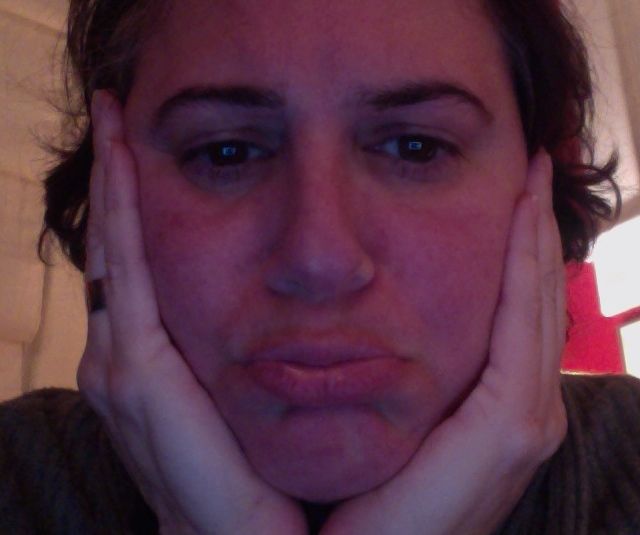
I lost my job, one I’d devoted myself to pretty seriously for seven years. And the way that happened is a long, complicated, boring story. Suffice it to say it was unfair, and that everyone involved knows it was wrong and unfair. While I am quite happy not working there anymore, I am still angry as hell over what happened, and also about who continues to enjoy undeserved, unearned employment there. I am stuck in a stage of the grieving process. However, I’m not allowed to discuss it. The people I know who work there don’t want to hear it, worry I suppose that I might show up and open fire (remember, an angry woman is crazy). My in-laws don’t want to hear a word against the place because of their own association with it, and because bad news and bad feelings make them uncomfortable. My own family is sympathetic but at too much geographic distance to fully understand what happened. And so no one has talked to me in a way that expresses sympathy. One former co-worker has admitted in private conversation that I was mistreated.
One. In private.
So I am full of self-pity, because no one feels bad for me. We “take pity” on people who need our mercy or charity, but women are rarely taught to treat themselves with the same kindness they are expected to show everyone else.
But let’s consider this woman’s concern with women’s anger that is self-righteous or self-pitying. First, why is her first thought that this is what another woman’s anger would be? Second, I’d say she’s looking through a sexist male lens, casting a male gaze where she should be using her own. Maybe this is because she works in a traditionally male field, and it was her husband who was home with the kids most of the time that I knew her. It is the comment of someone who doesn’t want to sound too much like a woman, if you ask me, someone for whom that might be an insult. How sad.
I feel pity for her.
“Because I’m a good writer.” That’s what my friend said when I asked her how she avoided feeling crushed by rejection. In the first millisecond after her response, I was taken aback, and then I listened to her. She knows what she likes to read and what she likes to write. She is, in fact, an excellent, lyrical writer. And what she had to say got me thinking about my own attitudes, why I feel so ready to quit at each rejection (I will say that every writer I know gets published, and that I don’t). She knows that some people will like her words and some people won’t, that editors’ decisions are subjective, and she trusts herself to know that her work is good. If editor A doesn’t want it, there are always editors B-Z. She has gone to bat for stories that other editors at her magazine reject, and she has rejected some that her colleagues love. That’s just how it is.
I don’t think I would ever say, “I’m a good writer.” But why?
Is it because I’m not?
It’s more complicated than that. Sometimes I love what I’ve written, and sometimes I don’t. Either way, I work at it, go back over it, rewrite, edit, revise, and so on. I am not the most talented writer in the room, and I know other writers whose work makes me feel that I have a long way to go. But I know when I’ve done good work, and I know what I like to read. And I know that some people, at least, like what I produce. So why does one rejection make me feel that I’ve been fooling myself, that my friends have been lying to me, and that maybe, this time, finally, I should just stop?
My friend’s answer got me thinking about more than just writing. I needed to examine why I was taken aback–if only for a moment– by what she said. And it hit me what it was. She had the nerve, the ovaries, if you will, to just go ahead and say it. Women are not encouraged to own their talents and skills in that way. And when they do, it makes the news (see Mo’Ne Davis). Women apologize, women demure, women self-deprecate. We don’t come right out and tell people we excell at anything. Because when we do, we earn certain labels. We’re not confident, we’re conceited. We’re not bold, we’re bitches.
How we lea rn to think and talk about ourselves tends to be molded by another thing we’re taught; that these need to be adjusted to make others feel good, or at least to avoid making them feel bad.
This is especially galling to me now, as I am watching my own daughter’s confidence disappear. She whispers her answers in her math class, she droops her head when we review her homework, she is crushed by the smallest suggestion that something could be improved. Just a few months ago, she was so confident that she would try out for teams though she’d never played the sport. She figured if she just tried, she’d make it. She was wrong, but she was undeterred. She decided to quit guitar lessons and uses the Internet to teach herself chords. The one thing she knows she’s good at is singing, but she’s told me she doesn’t like it when her friends comment on it, because she doesn’t want them to feel bad about their own voices. And there is no battling this; no matter what we tell her about her talents and abilities, we can’t bring her confidence back. We’re hoping she just needs a change in her epilepsy medication.
The only time I’ve been brave enough to say “I do it best” is when I talk about my challah, which I bake each week. Oy. So much for feminism. Why is it so difficult, frightening, even, to feel and say I’m good at something? What a terrible shame not to feel entitled to that.
Yom Kippur, the day of atonement, begins this evening. We are supposed to humble ourselves before God, ask forgiveness for the wrongs we’ve committed, forgiveness for the community, and ask for help to do a better job in the coming year. We spend hours depriving ourselves of food and drink to “afflict” ourselves, but I believe also to better concentrate on the things that motivate us other than hunger and thirst.

Size matters.
If you don’t believe in God, this can seem pointless–humble myself before what, now? My twelve-year-old thinks all the God stuff is too much. I know what she means. But I don’t want her to think she can stay home from shul; I want her to find meaning there. I go for a couple of reasons–I like my background and traditions, and that means attending services. But I also need to spend time reflecting on who I am, who I have been, who I might become. I want to think about how I have treated people, how I have reacted to local and world events, what assumptions I make and have made. I am not worried about God. I am worried about the ways I affect other people.
Some years ago, I had a falling out with a friend. I’m not sure exactly what happened, but we got angry and then she refused to have anything to do with me. I tried communicating with her. Nothing worked. As the high holidays rolled around, I thought I’d try one last time. I wrote her a letter explaining that at this time of year I try to make right what I have done wrong and why. I asked for her forgiveness. She did not respond. I heard later that she felt I wrote the letter because my rabbi told me to. Huh? I have never been able to repair the damage, and this weighs on me today–maybe not as much as it did in 2011–but I still think about what went wrong, and what I did that so angered and hurt her. I certainly loved her, and she had become like a member of my family. My children missed her for a while. I don’t want to be the woman who hurt her friend. I do not accept all the blame, by any means. I think my friend had difficulties forming close relationships; she spent time making herself unapproachable and unattractive, closed off from the world. And so I think about how I might be a better friend, a more sensitive and careful person. Not everyone can handle my usual mode of operations.
Another thing that haunts me is a story that has been in the news. When Hannah Graham went missing from UVA, it was big news. She is white, and that always gets attention. Around the same time, two African American women went missing (and were subsequently found murdered), and I never saw it in the news. So I understand the frustration about how law enforcement and media pay so much less attention to non-white victims. I am not surprised if a community rises up in protest against the murder of a young black man, nor am I shocked when reporters try to bring up his record or history, allowing white viewers to feel less bad about the death.
So when the investigation into Graham’s disappearance began with a white guy telling police he saw her with a black guy, I was suspicious. Then they found out who this man with the dreads was, and his picture was everywhere. His face is doughy, child-like, soft. He looks harmless, however large he is. So there really was a black guy, I thought. I felt relief that the other man had not been making it up, playing on the racism he knew he could use. And I began to accept Matthew’s guilt, even though I knew the police were not sure he was their man. Then I had to ask myself a hard question–was I assuming his guilt because he’s African American? His family and friends describe Matthew as a “gentle giant,” a sweet guy who wouldn’t hurt anyone. They don’t believe he’s done anything. And I wondered, are there African American people watching this story unfold and assuming his guilt the way I am, or are they legitimately suspicious of the process?
The evidence has been piling up against him; there’s a string of missing women and assaulted women in his wake, so it’s not looking good, unusual though a black serial killer is. But this is another part of me I must confront and examine this Yom Kippur; whether Matthew is guilty or not, what am I guilty of?
We’ve been talking to our daughter about the choices she makes, trying to show her how to accept responsibility for what she does and the consequences. She’s only twelve, so it isn’t easy. But things seem to be falling apart around her, and I’m not sure how to help. I see her losing her grip on her schoolwork, being distracted by boy bands, anime, and fan fiction. I see her refusing to study for her bat mitzvah, viewing my attempts to help her as punishments, thinking of herself in increasingly negative terms. Going to shul also came up in this conversation; that’s when she told us she wasn’t so interested in God. I tried to impress upon her that it’s a good time to think about herself, to imagine how she wants things to go and how she might make sure they do go that way. She’s only twelve, so it isn’t easy. And I wonder, is any of this my fault? Have I made her feel bad about herself? Have I not supported her in the way she needs? What happened during my pregnancies to give me one child with epilepsy and another with autism? I push those last thoughts away, though, because they’re useless. I can’t change anything there.
And maybe that’s what is inspiring about Yom Kippur, God or no God. It allows me to look forward rather than back. Sure, I think about what I may have done wrong, but the past is in the past. There are lots of things I can’t change. But I can do some good–for people I know, for people I don’t.
It is what I’ll do tomorrow that matters now.
As I heard on the radio this morning, I am like the majority of Americans–fall is my favorite season. Fall brings weather I like (at least back home), clothing that makes me comfortable, a few of my favorite holidays, my birthday, and, because I’ve been tied to an academic calendar for so long, a sense of beginning, of possibility. The same feeling I get with a new notebook.
So it took me by surprise today when I thought it was all over.
I had gone to the doctor for an ultrasound because I’d been having some mild pelvic pain. It was over cautious, really, but as I’ve already experienced one breast cancer scare, I don’t like to take chances, and my doctor agreed. I have no idea how to look at an ultrasound, especially if it’s not a well-developed baby I’m looking at. So the technician is moving the wand around in there, and this big black blob shows up in the picture. She is interested in this blob. She keeps measuring it from all different angles. I am trying to remain calm, even crack a joke with her, but she is all business, which scares me. When she’s done, she tells me to wait outside the lab area for my blood pressure and other vitals to be taken. So I sit.
Before I’ve been there even a minute, my eyes fill with tears. I have cancer. My kids will have no mother. I am going to get very sick, have treatments that will make me very sick, and then I am going to die. I cannot stop. Maybe it is a panic attack. But there I am in the hallway with tears running down my face. I am not like this. I’m not much of a crier, not a hypochondriac, but I realize that I was terrified. My doctor walks by and sees this mess. “What happened? Did she find something? I haven’t even seen them yet! Come with me, you’re fine, we don’t need your blood pressure.”
She whisked me to her office, where she looked at the results and told me repeatedly that everything was fine and entirely normal. The blob looked big on the screen but was a typical follicle, unusual in no way. I mopped my face and blew my nose. She sent me on my way with a hug and instructions to freak out about something else. She probably thought I was nuts, but she was very nice about it.
For the rest of the day I should have been elated. I’d been to the brink of death, and I’d been pardoned. I could go home to my family. But I was in a fog. I wandered around in stores, hoping to find a dress to wear for Rosh HaShanah. Everything looked weird or meant for a much older woman. And I was dressed for the gym, not shopping. I bought a hair dryer.
Later when I went to pick up my daughter from school, I missed my turn and found myself on a bridge headed out of the city. A few careful moves later, I pulled up to her school just as she came out. I texted my husband. “I’m going to need a good long hug when you get home. I’m a mess.”
By the time I’d put away the groceries, I felt more calm, and I took the dog out for a walk. My dog loves me like no one else. You can see it in the way he looks at me.  When I’m in the right mood, the dog walk is perfect. It was cool outside, I was feeling better, and Max was being good, not pulling on the leash. He did his business, and when I bent down to clean it up, my back objected. Strongly. I stood up slowly and “ambled” home. My daughter helped me sit on the couch. My husband came home and gave me alcohol. The ibuprofen is kicking in, too. So I can feel the return of that September mood, that sensation that things will be clean and new, that I can make them that way and begin again. I can’t bend over right now, but maybe upright and eyes forward is the best way to greet the new year. L’Shanah Tovah.
Beautiful work by Adam Isler
The meaning of life is to find your gift. The purpose of life is to give it away.
–Pablo Picasso
Check out my post today at http://sevencitieswriters.wordpress.com
(Go Back to Cheder)
 I really was a Hebrew School dropout. I never had a bat mitzvah, never finished the formal Jewish education I was “supposed” to have as a kid.
Like a lot of Jewish kids, I hated going–it sucked to spend the entire day at regular school only to have to put in two more hours, twice a week, after school. I didn’t mind being Jewish, most of the time (Christmas was tricky), but I didn’t feel anything about it. It didn’t matter to me as a religious feeling, or a culture and set of traditions. I wasn’t ashamed of it, and I may even have been proud, but I didn’t care a whole lot.
Since I lived in New York, I didn’t have much trouble with my identity as a Jew, except Monday through Friday, 8:00-3:00. People think of the city as a Jewish place, and of course, compared to the rest of the U.S., it is. When I was going to school in the 1970s, though, on the edge of Spanish Harlem, I spent my days in a school where the only other Jews were my older brother and most of the teachers. My friends and classmates were black, Dominican, Puerto Rican. With the exception of one Muslim kid (I’ll never forget you, Abdul), everyone was Catholic or AME.
At home, our building was one of the last before the entrance to the FDR Drive, the road that people took to get on bridges out of the city. Between us and the highway were a few brownstones, a vocational school, and a gas station. The presence of the gas station shows how “on the edge” of the city we lived. We were in the heart of it, sure, but it was a short walk to the East River. It was also a short walk to the place where the subway comes up out of the ground, where the rents are lower because the train may rush past your window. It was an even shorter walk to the projects many of my friends lived in. It was its own kind of edge.
I played outside all the time (as we did back then), with kids from my building or block. We played with Matchbox cars; we played red light, green light; red rover; tag; hide and seek. After I read Harriet the Spy, I used to sit with a small spiral notepad and pencil under the windows of first-floor apartments, hoping to overhear some morsel worth recording. We rode bikes and got in fights, and ran across 96th Street to play in Whitey’s Park, where Mr. White would unlock balls and other playthings from a small building that also housed bathrooms. And if we fell down, Whitey put mercurochrome on our raggedy knees and let us blow the bright liquid into patterns before it dried. He must have been a city employee; such a full-service playground is unimaginable to me now.
I had a mouth on me–it came from defending myself regularly, not just against taunts, but fists, too. I threw around the f-bomb expertly by the time I was in 4th grade. I kinda had to. I was a “honky Jew,” who “hated Christmas,” and didn’t look like everyone in my class. My first boyfriend (the dimples he had! That afro!) was influenced to dump me after a week by classmates who felt he needed to be reminded I was white. And I didn’t think of myself as white. Not the way they meant it. They meant people who had lots of money and ate mayonnaise on their sandwiches and had blue eyes, and went skiing. People who weren’t ethnic or lower middle class.
And I was so envious of the black girls’ hair, and their braids and exotic hairdos their moms gave them. I had thin, fine hair, and it didn’t do anything good. I was envious of the clothes the other girls wore. My parents never let me have shoes with heels, or coats with fake fur trim. The year those coats were “the thing,” Mom and Dad got me a red plaid wool coat, double-breasted, with two rows of gold-colored buttons. I could feel the punches I was going to get long before they landed.
When it was time for Hebrew School, my brother and I would walk out of Harlem and up the hill to Park and Madison Avenues, then downtown a little way to our synagogue. The change in scenery helped prepare me for the change in culture I was expected to make on Monday and Wednesday afternoons. Usually, there was a bit of time to play outside, so we did, but then off to classes to learn the Hebrew language, prayer, history, Torah. My classmates all went to school at places quite different from mine–either P.S. 6, which was in the kind of neighborhood where all the kids were white and middle class, or any of a number of private schools. They were nothing like my friends. I did not get along with most of them, and most of them did not know what to make of me. They tormented me in different ways, especially after I was forced to return to class after weeks of playing hooky.
I didn’t like the kids, but after a while I didn’t care much for the God the teachers taught, either. It turns out children can have crises of faith, and mine came when we learned about Cain and Abel. I got stuck on the part of the story in which they give offerings to God, and Cain gives God fruit which he finds on the ground, and is therefore overripe, maybe bruised, whatever. These days, of course, I’d have argued that he was a fruitarian, but at the time I was sensitive to the plight of those who have less, surrounded as I was by rich white kids. I asked the teacher, “But what if that was all Cain had to give?” My anger at this terrible God, this insensitive unseen, was boiling up in me. I was outraged, but I asked the question as politely as I could.
“That’s not the point of the story,” the teacher said. I’m pretty sure that was the last time I went. So, no bat mitzvah.
My daughter’s bat mitzvah is in January. She hated Hebrew School and felt different from a lot of the kids there. She thought they were snooty. I wish she liked it. But that’s how it is. Is anything different for her, though? She never would have been able to drop out as I did; we live in a car-centered city. She was picked up and driven to Hebrew School. She is going to finish what she started. She feels at home in our synagogue, even if she doesn’t want to be there.
But she believes in God, and I don’t.
WORKING CLASS LITERATURE #POWERTOTHEPEOPLE
A Frequent Blog of Devotionals Inspired by A Course in Miracles, A Course of Love, The Way of Mastery, Choose Only Love--Plus More . . . with Celia Hales - https://www.amazon.com/author/celiahales
A writing WordPress.com site
photographic visual artist
A (Hopeful) Writer's Notes
Thoughts from a Buddhist practitioner
By Yoni Marten
Essays Exploring Craft and the Writing Life
We live to write and write to live ... professional writers talk about the craft and business of writing
Howdy! We're the largest independent bookstore in Texas. This is our blog.
This site is all about ideas
"A Word of Substance"
every best bloody mouthful
The Art and Craft of Blogging
The latest news on WordPress.com and the WordPress community.


 Isler Ink