Jews Are Ruining Christmas, Again

chanukahtree

Monday was a great day; in the morning I went with my work partner and friend to look at a senior center where we might offer memoir writing classes. Afterward, we went to a pleasant coffee shop to have a drink and talk. Then my friend showed me a great used book store–the kind I like, a real rabbit warren of a place. The only thing missing were creaky, wood floors and bookish tweed-wearing clientele in dark corners. We asked for art books, and the woman running the place, a short, plump woman with grizzled gray hair and an open face, showed us where they were.

When I was paying for my books, I got into a conversation with the bookseller that I wish had never happened.

The Roosevelt Field Mall on Long Island had changed up its traditional mall Santa photo area, and instead of trees and elves and icicles and candy canes, there was nothing but Santa and a futuristic sort of clam shell, intended to be a glacier, to block out all the shops from the photos.

The comment thread on the article I read was full of angry customers talking about how ridiculous this was, and they were all suggesting in indirect and direct ways that “people” had complained about the traditional set-up, and that’s why this horrific change had taken place. As someone who doesn’t celebrate Christmas, I’m well aware of who these “people” are they’re talking about. One guy just went ahead and typed, “Keep the Jews out of Christmas!” Clearly, this man does not know too much about his messiah. And that’s really the part of the story I wanted to talk about, because it was funny–about the guy who doesn’t know Jesus was Jewish.

The bookstore woman, who is actively trying to restore a Santa tradition that’s outside her local mall said, “Oh, yes, I read that story too! Just ridiculous.”

We agreed; if you’re going to have a mall Santa, you might as well have the decorations that go with it. But that wasn’t all the bookseller had to say. “People complained,” she said, “you know, people, from…from other religions.”

Uh-oh.

“Actually, I don’t think so,” I said. “It was just some odd corporate decision to have this sleek, modern Santa setup.” I hoped I was right.

If Christmas weren’t an important holiday economically, I’d be a big fan of getting the whole thing out of the mall, out of my kids’ schools, out of public spaces generally. It’s hard for December revelers to know what it’s like to be so inundated and overwhelmed with a religious holiday not their own. And so very many people don’t treat Christmas as the religious holiday it is, so they don’t know why their nativity scene is a bother. Because they see it as an American holiday rather than a Christian one, they are frustrated by anyone’s no-Christmas-in-public-spaces stance. And if it’s an American holiday, where does that leave American Jews, American Muslims, American Hindus, American Buddhists, and all the rest of us? I like many things about the holiday; some of the music is lovely. I like that it makes my Christian friends happy. I like looking at over-decorated houses. In New York, I always enjoyed walking past the tree sellers and deeply inhaling the sweet pine scent. It always felt even more special somehow if there was snow on the ground. People were cheerful; my office was full of treats homemade and mailed in, and I was invited to parties. I also like to pick special gifts for the Christmas-celebrating folks I love. But at no point do I forget that the holiday celebrates the birth of the Christ child. And that’s why “Merry Christmas” is annoying, even if it’s well-meant.

Try to imagine how you might feel if it seemed the entire world was celebrating a Middle Eastern-style Muslim holiday; everywhere you went, from Target to the drug store, even the vacuum repair shop, the library, school, the office, the walls were decked with Middle Eastern decorations. America is Muslim, and you are the Christian minority. Every time you went shopping for anything, you would have Middle Eastern holiday music in your ears. This music would burst forth from loudspeakers on mosques and masjids all over your city, on the hour. Everywhere you went, people would wish you “Eid e Milad un Nabi!” Sounds interesting, actually. Year after year, though, as you waded through this tsunami of exclusion, you would begin to resent it. You might even say, “what about my holiday?” And then you might inflate a minor holiday on your calendar in an effort to combat your sense of drowning. You could get decorations for your holiday from niche market internet stores and be the lone house on your street decked out in the wrong colors. You would try to make this minor event exciting for your kids so that they felt less excluded, so they could feel good about the traditions from which they come, so they would not feel crappy about not being a part of the culture of their country.

But back to the bookstore. After I suggested that the new mall décor was a corporate decision, the woman behind the counter said, “Probably the Jews.”

I said nothing. What could I have said? “Uh, I’m Jewish”? I took the books I had already paid for (I dropped $47 in that goddam place) and walked out, saying nothing.

I got back into my car, and as I moved down the road, I realized I was in shock. I felt as though a stranger had walked up to me on the street and slapped me in the face hard enough to bring stinging tears to my eyes. I am used to reading anti-Jewish sentiment online, particularly as December approaches. But as much as I am aware of antisemitism, I have rarely had anyone say something so directly hostile to me about Jews. I’ve had people make stupid jokes and comments, and ask poorly worded, ignorant questions. But that is nothing to having someone look right at you and blame you for something–in a voice full of derision.

I have talked to my kids about white privilege, about the issues African American (and other non-white) parents worry about while their children are out and about, things that we do not think about. I have talked about the injustice of that, have tried to make them understand that encountering the world is different for different people. And I think they get it. But only as much as one person can understand someone else’s experience.

There’s no denying that this country has been far better to my people than most other places around the world; one might argue that it is still the safest place on earth for a Jew to live. The time when people put signs in the window telling Jews, Irish, and Blacks not to apply (for the job or apartment) has passed. There’s no sign in the window. Now it’s a secret.

Jewish people live with the secret every day. It doesn’t compare to the experience of a brown-skinned person in America, though. Most Jews (except Jews of color) live safely cradled by their white privilege. They don’t fear that their sons will be shot by the police for no reason. They don’t get followed around stores as though they were criminals. Getting a taxi isn’t a big deal, except at rush hour. They aren’t hypersexualized by the media. They don’t feel a need to live up to some notion of their existence imposed upon them by other people. They aren’t considered lazy or freeloaders or welfare queens or drug addicts. Mostly, Jewish people are ignored, except in December, when American Jews insist on playing up that pesky little festival, Chanukah. We are invisible.

And that’s where the trouble is. Because someone who has a problem with African Americans, or Latinos, or Asians, or Arabs, for instance, will always have a problem with us, too. We are on “the list.”

My husband used to find it very funny that I didn’t think of myself as white. But it is this list that makes me say so. Reasons to hate us are about the same as the reasons to hate the other groups; stereotypes, fears, ignorance, and intolerance are layered on top of one another so that such people walk around in a shell of their own stupidity so thick that knowledge actually just bounces off it. And of course, our presence means lots of annoying and hypocritical “holiday” parties and “holiday” trees and the like. Sometimes someone will mistake me for a white person and say something derogatory about blacks. They think I’m in on the joke, but the truth is, I am the joke.

I have thought before that I would write about being a member of an “invisible minority.” A man wearing a kippah is a man showing the world to what group he belongs. But for most American Jews, there are no outward signs. Unless you believe we all have big noses and bad hair. So people disparage us right to our faces; most would probably not say anything hateful if they knew who they were talking to. This kind of racism scares me because it is in hiding. And it’s terribly hard to fight what you cannot see.

* * *

See a Facebook page devoted to boycotting all the malls owned by Simon malls: https://www.facebook.com/BoycottSimonMalls/timeline

The original description of their raison d’etre (since softened considerably): “This is a page dedicated to boycotting Simon Malls new glacier Santa experience. Apparently they’d rather please the minority [italics mine] & not the majority.”

The mall’s response: “We’ve listened to our shopper feedback the last few days and the idea that we eliminated Christmas trees in order to “not offend” anyone is simply not true. We’re still adding in key elements to the Santa set this week and after hearing our customer concerns we will now be including a traditional Christmas tree as one of those elements. Together, the mix of traditional and modern design will create a magical North Pole and a new family tradition. Come and explore this modern and interactive experience.”

FYI, it’s not just the defenders of Christmas, either; others have also called for a boycott of Simon malls: http://www.2acheck.com/boycott-simon-malls/. These guys are pissed that they can’t come to the mall fully armed.

The “Writing Life,” as Explained to Me by an Expert

When I was working on my second graduate degree, an MFA in creative writing, someone had the brilliant idea to bring in professional writers to talk to us about the writing life. Unfortunately, the guests weren’t always as great as the idea itself. One evening, as we gathered around the conference table, the speaker was introduced to us by our professor–that night’s guest had been in school with our quite successful instructor, who had published a number of books, one of which got a lot of national attention. Her friend, well, not so much.

Nonetheless she was a writer and therefore qualified to talk to us about what it’s like to live that life. I was certainly the oldest student in the class, but most of the time that was not a problem for me. This evening, though. Well. We were told to max out our credit cards, whatever we had to do financially so that we wouldn’t have to let employment get in the way of writing time. We were told not to have kids whatever we do, because there was no way we were ever going to write anything if there were kids taking up our time. My favorite part of the conversation was when a classmate asked about getting an agent. Our speaker had an agent, all right–our professor’s. Seems the best way to get one to me! Hope I have a really successful writer friend who hooks me up, too.

Instead of laughing maniacally and calling her a nutbag, I will address her points one at a time.

  1. Telling young people to max out their debt has got to be the stupidest, most irresponsible piece of advice I’ve ever heard. Clearly the woman never wastes time reading a newspaper. Nothing like starting out a life likely to be impecunious with staggering, unpayable debt.
  2. I sat there, a mother of two, while she told us that mothers won’t write a word. Did I mention I am a mother of two, one a child with special needs, was a full-time college professor, and a full-time graduate student, taking care of my kids, writing my butt off?
  3. The right response to the question about agents would have been, “Don’t worry about an agent while you’re still working out who you are as a writer.” Additionally, she might have said, “I can’t really speak to that, anyway, because the only reason I have an agent is that my famous friend did me a favor.” That’s the kind of honesty we can all get behind, isn’t it?

Here’s what my writing life looks like. My alarm goes off at 6:30 am, and I begin the long and torturous process of waking my teenager. That is, if I’m able to bound out of bed right away, which is unlikely, given that my nine-year-old has been in bed with us, kicking me all night. In the kitchen, we drink coffee and make lunches and feed the dog and discuss when the dog walked and how much he pooped.

When everyone is ready, and don’t mistake this as a simple process–there’s yelling and crying and demands for weird breakfasts and a lot of “has anyone seen my…?” before anybody is ready to head out the door. Husband and son leave first. Then I drop my daughter at her school and pray I don’t get a call ten minutes later asking me to go home to retrieve whatever she forgot. On a very good day, I go from there to yoga. Home for a shower, a dog walk, food, and then writing and reading. That all happens if I don’t have groceries to buy, other errands to run, appointments, cleaning, cooking, and other minutiae to tackle (a bad day). I used to do all this stuff while holding down a full-time job. And in all honesty, I don’t know how I did it.

If I’m very lucky, I get two hours that are all mine. In that time, I write, I do research, I read good books (right now I’m reading We Need New Names by NoViolet Bulawayo, and it’s fantastic).

Then it’s time to pick up kids, deal with homework and dinner and extracurriculars. After dinner, there may be time to read some more, but now I’m too tired to write. Bed sometime between 9:30 and 11, ready to do it all again the next day.

And that is as much a writing life as the one this woman tried to sell us that night. It’s just a bit more firmly grounded in reality.

Next time: Rage vs. Outrage

I Miss My Daughter

My almost-thirteen-year-old girl still lives with us–at least I think so. Sometimes I’ll hear a sudden burst of laughter or a snatch of her singing emanate from the direction of her bedroom, so I’m pretty sure she’s in there.

I see so many images of the American teenager, jokes about their refusal to look happy in front of their parents, their retreat into the world of their headphones, cell phones, video games. It’s a stereotype. And it’s one I was sure we were avoiding. We have family time–Friday night dinners, movie night, post-Sunday-school lunches out, walks. We used to have a story time and a game night, but the kids couldn’t agree on the books, and now my daughter won’t play board games. So we have game night with our son.

But it feels wrong. She finishes her dinner before the rest of us, and she leaves the table, disappearing into her room in a hurry to get back to One Direction, FaceTime with her BFFs, her DS, her drawing. We’ll get home from school, and she’ll put her stuff down and disappear. When we are sitting in the living room reading or talking or watching something our son wants us to see on his iPad, she’s in her room. When we watched Cosmos as a family, she was willing to be in the room with us, but she was otherwise occupied.

I have confronted her, especially since she spends all that time in her bed. I know what depression looks like, and this has me worried. She insists she’s not depressed. Most recently she told me her room is the only place she “fits in.” But how could this be true? Her friends love her, her family loves her, we are always trying to get her to spend time with us. She’s smart and funny and fun to hang out with. I have even made a rule that she is allowed a certain amount of alone time after school, and then she needs to COME OUT OF HER ROOM.

This has been bothering me for a while, but tonight it really hit me. I was out with the dog and the kids, having asked them to come with me on a walk. My son insisted on riding his scooter, and my daughter insisted on bringing her phone and headphones. She could not hear me when I spoke to her, and she made such a show of pausing the music so I could repeat myself that I just said “never mind” and walked on. I’m the grownup. I make the rules. But I’m human, and this hurts. I was walking alone, the dog intent on squirrels, my son hell-bent on self-destruction, my daughter lost to the song Harry Styles was singing just to her. Maybe this is the way of things. She is growing up, separating herself from me, having opinions different from mine, wanting ideas just for herself.

I want her to be independent, to have thoughts and opinions. But I also want to guide her, to help her think about the world so that those opinions are grounded in something beyond a rumor spread on the internet. I want to help her negotiate friendships and middle school and puberty and mean kids. I want to make sure she knows what to do in moments of danger.

She is open with me about a lot of things that many kids are not. Her confidences give me hope that she sees me as a safe person, as someone who can be trusted with her secrets or confused pubescent sense of self. We share many happy moments, singing, lusting after Harry, joking, being gross, cuddling. But the spaces between these moments are growing wider every day. So I treasure them, because I know I’ll spend the rest of my life missing her more often than not.

Survival of the Mitzvah-est

My daughter became a bat mitzvah at the end of January. She killed it. She sings “like an angel,” my husband says. She gave a d’var torah (a lesson on scripture) about allowing people to be who they are, about suicide among LGBTQ youth. My pride in her knew no limit.

As she had requested, I learned a bit of Torah for the service. I was terrified, but I learned it, with the excellent help of the cantor, who has been (I think mistakenly) let go. I wore a hat, which I often do, but I also wore a prayer shawl, a tallit. I had no choice–the ritual committee would not budge on this point. Ya wanna read the Torah, ya gotta wear the tallis. I could refuse, and disappoint my kid, or I could suck it up. I sucked it up.

I felt a little better about it, because I was wearing a tallit that had been lent to me by the cantor; it was one he had designed and had made for his daughter. He was of a mind that the women’s garment should be a bit different, so the sides were partially closed to make arm holes. The blessing was embroidered on the collar by his wife. I was honored that he saw fit to lend it to me. It didn’t change my thinking that the tallit is a man’s garment; as I’ve said elsewhere in this blog, I’m a fan of custom and tradition. I’m conflicted about the roles women play in the synagogue. My ambivalence is no one’s problem but my own, but I wish people would not treat it as though it were a simple issue.

I was asked afterward how I felt in the moment, wearing it. The truth is, I didn’t think about it at all while I was up there, and I got a kind of “Aha!” response. But there’s no “aha.” I didn’t think about it because I was emotional about my daughter’s big day, my family’s bizarre decision to sit many rows away from us, and my own terror about what I was there to do–sing a prescribed tune in Hebrew words that have no vowels.

I was moved and excited by reading from the Torah. I memorized well. I felt nothing from the tallit, but the act of reading–that made me feel like I really was a member of the community, an active participant. The real deal. An emes yid. But that lasted only a little while and was soon replaced by the sense of being a fraud.

The bar or bat mitzvah must learn the trop; that is, the series of marks on the page that tell the reader how to sing the words–how many notes, where the accent is, etc. They learn it thoroughly, hopefully, and once they really know it, it becomes much easier to memorize a piece of Torah. And when they read their Haftorah (a short reading from the Prophets), the marks are on the page, along with the vowels. But Torah scrolls are hand-written by scribes, and they do not include vowels or trop. I never learned the trop. What I did, basically, was memorize a song, the same way I have learned the words to One Direction songs. I listened again, and again, and again to a recording of the cantor singing it. I hadn’t learned anything at all. I was not the real deal.

But let’s get back to the tallit. It seems to me that the tallit should mean something. My reaction should not be the same as when I get a flu shot–“Oh, that wasn’t so bad.” Here is a ritual garment over which one must pray before dontalllitpom-miriam-karp-webning it, and I didn’t think about it in any way past “guess I’ll have to wear it.” I feel no grand conversion, no desire to buy one for myself. No amount of pink or purple or beads or sequins will change that. I do not scoff at other women for this–I admire their beautiful shawls and support their decision to wear them.  I do believe it to be a personal decision, and not one my synagogue should make for me. I do not like to be legislated, when it comes to my body, and that includes my clothing.

It doesn’t stop there. Another way that women are being included in the service is adding the names of “the matriarchs” to one of the prayers–one. These are women who really aren’t discussed at any great length most of the year, but they are now receiving acknowledgment during the Amidah, the standing prayer. I’m glad we’ve added them. But let’s be realistic. It’s the equivalent of “I have a little dreydel” at a school’s Christmas, oh, excuse me, “Holiday” concert. Throw it in there, and “they” won’t complain.

Judaism is patriarchal. It will take a long time to change. I am a Jew. I take a long time to change.

I’ve Never Been a Torah-Kisser

As my daughter’s bat mitzvah approaches, I find myself confronting unexpected issues. Not clothing or caterers or guests, though those things are complicated enough. No, instead, I am banging into obstacles in the form of religious practice–what I will do and what I won’t, and most confusing of all, why.

Judaism, like all religions, is full of strange practices. On Sukkot we build an outdoor shelter in which we take our meals for eight days. We shake a lulav (an arrangement of palm frond, willow, and myrtle leaves) in the four cardinal directions. On Yom Kippur we don’t wear leather, and many wear white. In mourning, we rip our clothes and sit on low stools. Some sects swing chickens over their heads in the time between Rosh HaShanah and Yom Kippur. Like other traditions, there are special foods for each holiday, too. In synagogue worship, people touch the Torah with their prayer books, kissing the word of God. When they go up to read from the Torah, they use the fringes of their prayer shawl (tallit) to touch those words and kiss the fringes.

Almost all of these practices make me uncomfortable.

I don’t mean that I wish no one would do them (well, maybe we could call a halt to the chicken-torture), but that I, personally, feel odd about them. I’ve never been a Torah-kisser; for me, this is the worship of an object, and I don’t worship objects. I understand what the object represents, and maybe if I believed in God and had reverence for anything beyond customs and traditions, this wouldn’t bug me.

Some things I just never learned to do at all. My father, of blessed memory, taught me never to do a thing unless I did it “properly.” He meant well. But this has led to forty years of me avoiding things I might look foolish doing, things I won’t do right first time out of the gate, or things that are just weird (see lulav shaking).

Then there are issues of egalitarian worship. Judaism, like other religions you know, has traditionally treated women as second-class. Sure, they make up fancy mollifying reasons for this, explaining that men and women have different roles. But of course, that’s bullshit. Nowadays, women can be rabbis and cantors, they can be synagogue presidents. They read from the Torah and shake their lulavs all over town. Women-of-the-Wall-Torah-reading

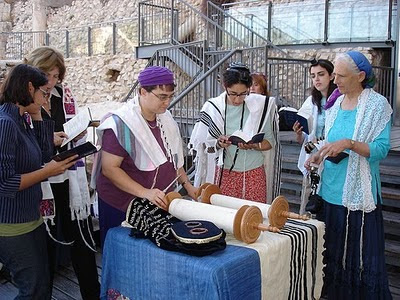
One way that many women have embraced their inclusion is by wearing a tallit and a kippah (yarmulke) to services. These are usually “girl” versions of the garments (because what girl doesn’t like pretty things?). So the prayer shawls come in many colors and diaphanous fabrics, and lots of women wear something on their heads made of wire and beads, a shiny, feminine version of a yarmulke.

When I spoke to my young, progressive rabbi about this, he made an excellent, reasonable argument. Head coverings and prayer shawls are required of all Jews that go up on the bimah (think stage) to engage with the Torah. So that includes women. Totally reasonable and logical.

But. For me, these garments are male. I am thrilled to be invited to the game, but why should I put on men’s clothing to play? Does that mean that being female is still problematic, that I must put on man stuff to be accepted? No, is the answer, go buy the women’s versions of these items. Except that these things are akin (for me) to the aisle of pink toys at every big box store. It’s insulting. I hate, I mean really hate, those beaded things people wear on their heads. They’re worse than the stupid doilies synagogues always offer women. They are distractions–look at the pretty shiny hat, young lady. I feel almost as though there’s something they hope to slip past us while we’re bedazzled by our beadazzled stuff.

Still, the rabbi’s reasoning makes sense. My husband said that the synagogue, then, ought to have women’s tallits available to borrow the way they have men’s piled up outside the sanctuary. The rabbi agreed that this is an excellent idea.

But now I have complicated matters further, because my daughter really, really wants me to read from the Torah on her big day. Am I just being stubborn? Am I an atheistic traditionalist like my father before me? Is my discomfort as basic as worrying about how I will look?

I have a month and a half to figure it out. Wish me luck.

Pity Is as Pity Does

Recently I posted as my Facebook status a bit of a rant about women and anger; that is, I said that women are not afforded the “luxury” of this emotion. Both men and other women are uncomfortable with it–the angry woman is unbalanced, maybe crazy, dangerous, or just laughable. Whatever the case, her anger will not be taken seriously or considered worthy of further thought. At times, I have been told outright to keep it to myself. I’m sure I will write more about women being denied this emotion, but for now I’d like to consider one of the comments my Facebook post received from a female “friend.”

She claimed she has no discomfort with women’s anger unless it is “self-righteous” and “self-pitying.” For now we will ignore how obnoxiously self-righteous her comment is, and focus instead on the idea of self-pity. What is it but caring about oneself? Something bad happened to me; I feel bad for me. Is that wrong? And if no one else expresses sympathy or understanding about the bad thing that happened, going so far as to prefer I didn’t talk about it?

Who then is left to feel bad for me but me?pityface

I lost my job, one I’d devoted myself to pretty seriously for seven years. And the way that happened is a long, complicated, boring story. Suffice it to say it was unfair, and that everyone involved knows it was wrong and unfair. While I am quite happy not working there anymore, I am still angry as hell over what happened, and also about who continues to enjoy undeserved, unearned employment there. I am stuck in a stage of the grieving process. However, I’m not allowed to discuss it. The people I know who work there don’t want to hear it, worry I suppose that I might show up and open fire (remember, an angry woman is crazy). My in-laws don’t want to hear a word against the place because of their own association with it, and because bad news and bad feelings make them uncomfortable. My own family is sympathetic but at too much geographic distance to fully understand what happened. And so no one has talked to me in a way that expresses sympathy. One former co-worker has admitted in private conversation that I was mistreated.

One. In private.

So I am full of self-pity, because no one feels bad for me. We “take pity” on people who need our mercy or charity, but women are rarely taught to treat themselves with the same kindness they are expected to show everyone else.

But let’s consider this woman’s concern with women’s anger that is self-righteous or self-pitying. First, why is her first thought that this is what another woman’s anger would be? Second, I’d say she’s looking through a sexist male lens, casting a male gaze where she should be using her own. Maybe this is because she works in a traditionally male field, and it was her husband who was home with the kids most of the time that I knew her. It is the comment of someone who doesn’t want to sound too much like a woman, if you ask me, someone for whom that might be an insult. How sad.

I feel pity for her.

Confidence Women

“Because I’m a good writer.” That’s what my friend said when I asked her how she avoided feeling crushed by rejection. In the first millisecond after her response, I was taken aback, and then I listened to her. She knows what she likes to read and what she likes to write. She is, in fact, an excellent, lyrical writer. And what she had to say got me thinking about my own attitudes, why I feel so ready to quit at each rejection (I will say that every writer I know gets published, and that I don’t). She knows that some people will like her words and some people won’t, that editors’ decisions are subjective, and she trusts herself to know that her work is good. If editor A doesn’t want it, there are always editors B-Z. She has gone to bat for stories that other editors at her magazine reject, and she has rejected some that her colleagues love. That’s just how it is.

I don’t think I would ever say, “I’m a good writer.” But why?

Is it because I’m not?

It’s more complicated than that. Sometimes I love what I’ve written, and sometimes I don’t. Either way, I work at it, go back over it, rewrite, edit, revise, and so on. I am not the most talented writer in the room, and I know other writers whose work makes me feel that I have a long way to go. But I know when I’ve done good work, and I know what I like to read. And I know that some people, at least, like what I produce. So why does one rejection make me feel that I’ve been fooling myself, that my friends have been lying to me, and that maybe, this time, finally, I should just stop?

My friend’s answer got me thinking about more than just writing. I needed to examine why I was taken aback–if only for a moment– by what she said. And it hit me what it was. She had the nerve, the ovaries, if you will, to just go ahead and say it. Women are not encouraged to own their talents and skills in that way. And when they do, it makes the news (see Mo’Ne Davis). Women apologize, women demure, women self-deprecate. We don’t come right out and tell people we excell at anything. Because when we do, we earn certain labels. We’re not confident, we’re conceited. We’re not bold, we’re bitches.

How we leaMo'Nern to think and talk about ourselves tends to be molded by another thing we’re taught; that these need to be adjusted to make others feel good, or at least to avoid making them feel bad.

This is especially galling to me now, as I am watching my own daughter’s confidence disappear. She whispers her answers in her math class, she droops her head when we review her homework, she is crushed by the smallest suggestion that something could be improved. Just a few months ago, she was so confident that she would try out for teams though she’d never played the sport. She figured if she just tried, she’d make it. She was wrong, but she was undeterred. She decided to quit guitar lessons and uses the Internet to teach herself chords. The one thing she knows she’s good at is singing, but she’s told me she doesn’t like it when her friends comment on it, because she doesn’t want them to feel bad about their own voices. And there is no battling this; no matter what we tell her about her talents and abilities, we can’t bring her confidence back. We’re hoping she just needs a change in her epilepsy medication.

The only time I’ve been brave enough to say “I do it best” is when I talk about my challah, which I bake each week. Oy. So much for feminism. Why is it so difficult, frightening, even, to feel and say I’m good at something? What a terrible shame not to feel entitled to that.

Who Will You Be? A Yom Kippur Rant

Yom Kippur, the day of atonement, begins this evening.  We are supposed to humble ourselves before God, ask forgiveness for the wrongs we’ve committed, forgiveness for the community, and ask for help to do a better job in the coming year. We spend hours depriving ourselves of food and drink to “afflict” ourselves, but I believe also to better concentrate on the things that motivate us other than hunger and thirst.

Size matters.

Size matters.

If you don’t believe in God, this can seem pointless–humble myself before what, now? My twelve-year-old thinks all the God stuff is too much. I know what she means. But I don’t want her to think she can stay home from shul; I want her to find meaning there. I go for a couple of reasons–I like my background and traditions, and that means attending services. But I also need to spend time reflecting on who I am, who I have been, who I might become. I want to think about how I have treated people, how I have reacted to local and world events, what assumptions I make and have made. I am not worried about God. I am worried about the ways I affect other people.

Some years ago, I had a falling out with a friend. I’m not sure exactly what happened, but we got angry and then she refused to have anything to do with me. I tried communicating with her. Nothing worked. As the high holidays rolled around, I thought I’d try one last time. I wrote her a letter explaining that at this time of year I try to make right what I have done wrong and why. I asked for her forgiveness. She did not respond. I heard later that she felt I wrote the letter because my rabbi told me to. Huh? I have never been able to repair the damage, and this weighs on me today–maybe not as much as it did in 2011–but I still think about what went wrong, and what I did that so angered and hurt her. I certainly loved her, and she had become like a member of my family. My children missed her for a while. I don’t want to be the woman who hurt her friend. I do not accept all the blame, by any means. I think my friend had difficulties forming close relationships; she spent time making herself unapproachable and unattractive, closed off from the world. And so I think about how I might be a better friend, a more sensitive and careful person. Not everyone can handle my usual mode of operations.

Another thing that haunts me is a story that has been in the news. When Hannah Graham went missing from UVA, it was big news. She is white, and that always gets attention. Around the same time, two African American women went missing (and were subsequently found murdered), and I never saw it in the news. So I understand the frustration about how law enforcement and media pay so much less attention to non-white victims. I am not surprised if a community rises up in protest against the murder of a young black man, nor am I shocked when reporters try to bring up his record or history, allowing white viewers to feel less bad about the death.

So when the investigation into Graham’s disappearance began with a white guy telling police he saw her with a black guy, I was suspicious. Then they found out who this man with the dreads was, and his picture was everywhere. His face is doughy, child-like, soft. He looks harmless, however large he is. So there really was a black guy, I thought.  I felt relief that the other man had not been making it up, playing on the racism he knew he could use. And I began to accept Matthew’s guilt, even though I knew the police were not sure he was their man. Then I had to ask myself a hard question–was I assuming his guilt because he’s African American? His family and friends describe Matthew as a “gentle giant,” a sweet guy who wouldn’t hurt anyone. They don’t believe he’s done anything. And I wondered, are there African American people watching this story unfold and assuming his guilt the way I am, or are they legitimately suspicious of the process?

The evidence has been piling up against him;  there’s a string of missing women and assaulted women in his wake, so it’s not looking good, unusual though a black serial killer is. But this is another part of me I must confront and examine this Yom Kippur; whether Matthew is guilty or not, what am I guilty of?

We’ve been talking to our daughter about the choices she makes, trying to show her how to accept responsibility for what she does and the consequences. She’s only twelve, so it isn’t easy. But things seem to be falling apart around her, and I’m not sure how to help. I see her losing her grip on her schoolwork, being distracted by boy bands, anime, and fan fiction. I see her refusing to study for her bat mitzvah, viewing my attempts to help her as punishments, thinking of herself in increasingly negative terms. Going to shul also came up in this conversation; that’s when she told us she wasn’t so interested in God. I tried to impress upon her that it’s a good time to think about herself, to imagine how she wants things to go and how she might make sure they do go that way. She’s only twelve, so it isn’t easy. And I wonder, is any of this my fault? Have I made her feel bad about herself? Have I not supported her in the way she needs? What happened during my pregnancies to give me one child with epilepsy and another with autism? I push those last thoughts away, though, because they’re useless. I can’t change anything there.

And maybe that’s what is inspiring about Yom Kippur, God or no God.  It allows me to look forward rather than back. Sure, I think about what I may have done wrong, but the past is in the past. There are lots of things I can’t change. But I can do some good–for people I know, for people I don’t.

It is what I’ll do tomorrow that matters now.